
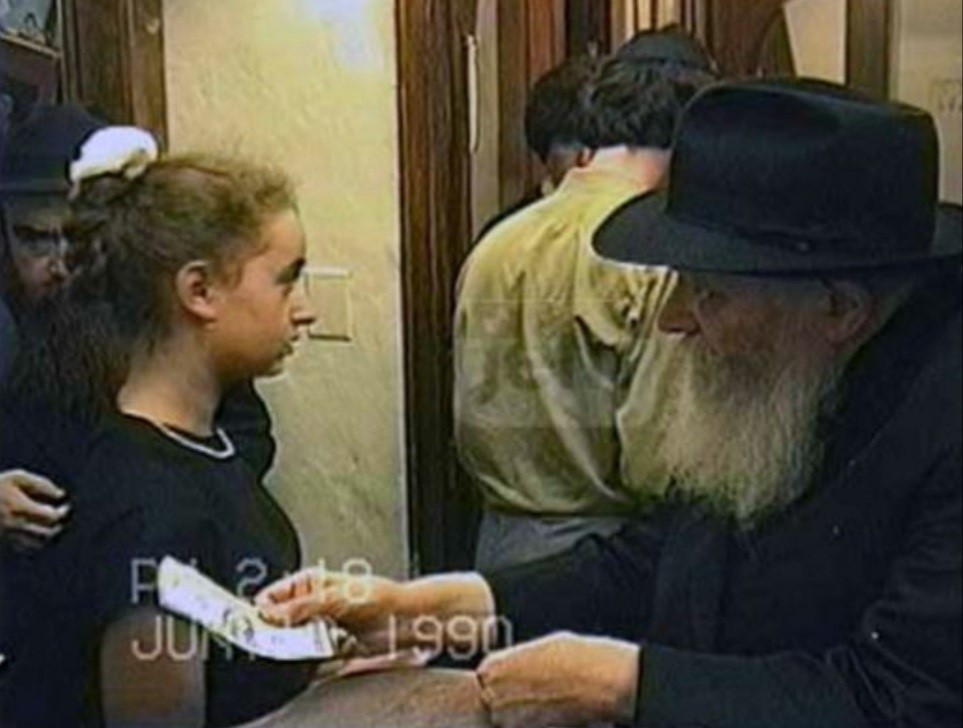
On June 10, 1990, my family was privileged to receive a blessing from the Lubavitcher Rebbe (https://www.chabad.org/therebbe/article_cdo/aid/4629440/jewish/Meeting-the-Rebbe-Meeting-Myself.htm),
a moment that has deeply shaped our lives. I marked the 35th anniversary of that life-altering experience with a visit to the Rebbe’s gravesite. Three and a half decades later, on exactly the same date and time, I stood at the Ohel, contemplating my journey and transformation.
My family immigrated from the former Soviet Union at the end of 1989. We were products of a communist reality—unaffiliated and unfamiliar with Jewish traditions. I was 13 years old when I looked into the Rebbe’s eyes and saw a reflection of my eternal soul. That was my moment of truth.
Since childhood, I suspected that my true essence wasn’t that of an atheist Soviet citizen. I couldn’t quite verbalize it, but I intuitively knew I was a spark of one magnificent fire. When the Rebbe’s eyes mirrored my internal light, my G‑dly soul, I finally had proof that everything I’d been taught in a Soviet school was a lie. I was a spiritual being, a link in an eternal Jewish heritage.
On that day, my intentions aligned with Jewish values, and it became my lifetime mission and responsibility to seek wisdom that would help me grow and evolve. As a leader of a generation, the Rebbe’s teachings permeated every possible aspect of daily life, and I continue to learn and grow from their profound and timely insights.
Yet, from the vast well of wisdom the Rebbe shared with the world, one message stands out to me as especially crucial in its relevance and vitality:
“The true greatness of a person lies in fulfilling their mission in life and acting in a way that brings joy and peace to the members of one’s family.”
The Rebbe repeatedly reminded those blessed with family that no ambition should be pursued at the expense of those closest to home. While searching for meaning and identity, I thought I needed to focus on grand accomplishments. Yet over time, I learned that inspiring the world begins with an unconditional commitment to the prosperity of an intimate circle of people.
In the modern search for identity, one’s worth is often measured solely by output or public recognition. But in doing so, we risk neglecting the most profound arena of purpose: the intimate, often quiet, space of home.
The Rebbe once responded to a woman who felt adrift and purposeless by pointing her back to her children. What she dismissed as ordinary, he reframed as extraordinary. To raise and shape another soul, he taught, is not a distraction from one’s mission—it is the mission. True purpose, the Rebbe insisted, cannot be measured by reach alone, but by responsibility—especially to those given specifically into our care. A career may touch thousands, but the soul of a child, a spouse, a parent—that is where legacy begins.
In my search for identity in a world of inspiring others, the Rebbe’s teachings entrusted me with a thermometer to measure the well-being of my immediate family.
In Judaism, the principle “charity begins at home” is not about preference, but about priority. The home is not a retreat from life’s work; it is life’s most sacred proving ground.
In a world increasingly pulled toward the expansive and external, the Rebbe offers a radical correction: the most expansive thing you can do is build a home rooted in love, integrity, and spiritual purpose. No matter how vast your mission, if it does not sanctify your closest relationships, it remains incomplete.
While visiting many Chabad Houses throughout the world https://www.chabad.org/theJewishWoman/article_cdo/aid/5163562/jewish/What-I-Learned-From-Chabad-Families-Around-the-World.htm, my husband and I always marvel at the synchronized dynamic of the couples who run the centers. The best way to inspire the world is by living a life that itself is an example of respect, love, and united mission.
The Rebbe’s relationship with his wife was an example to the world. He viewed the precious time spent with Rebbetzin Chayah Mushka, as sacred. As he once told Dr. Ira Weiss, the couple’s cardiologist: “The time I set to have tea with my wife every day is as important to me as the Biblical commandment to put on tefillin every day.”
The daily tea experience was not a break from his purpose—it was the purpose.
On June 10, 1990, at exactly 2:18 p.m., I shared physical space with the Rebbe for only a minute, yet the spiritual light of that monumental encounter has permeated the decades of my life. I have focused on actualizing the blessing the Rebbe gave me and have built a life based on Torah values, committed to inspiring myself and others.
Standing at the Ohel and giving an accounting of my life, I am reminded of the most profound wisdom the Rebbe taught: to always remember to continuously strengthen and prioritize the sacred bond of family.
Let me know if you’d like a shorter version, a more formal tone, or help shaping this into an article or speech.