
To celebrate our 10th anniversary, my husband and I took a trip to Australia.
Having grown up in the former Soviet Union, we both had little knowledge of our Jewish identity and were taking slow steps to reclaim our heritage.
My return to my heritage was inspired by a blessing of the Rebbe when I was 13 years old.
To be honest, learning about traditions overwhelmed me. There was so much I didn’t know. Shabbat, kosher laws, mikvah, prayer, Torah learning … the list was endless. The more I learned, the more I realized how much I still did not know.
I was motivated to grow, to make up for the years spent behind the Iron Curtain steeped in Soviet propaganda, where schools preached atheism and, for generations, students could not graduate unless they passed an exam “proving” the absence of a Higher Power.
I viewed every mitzvah as a precious diamond I was determined to collect. Yet my husband and I questioned how much we could actually incorporate into our daily lives. Finding it more than we could handle at one point, we slowly plateaued.
That is exactly when, by Divine Providence, we set out on a cruise to Australia.
When we docked in Melbourne, we decided to visit the Jewish museum.
Joined by a group of about thirty people, mostly non-Jews, we followed our guide from one exhibit to the next. Behind the glass were the displays of Jewish objects.
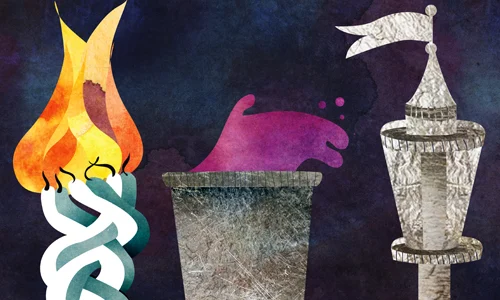
Among the books, documents, and ritual items, we saw a beautiful Havdalah set with a candle holder, spice box, and goblet. Our guide pointed it out and described it as “a ceremonial set that was historically used to mark the end of the Sabbath.”
I was immediately struck by the jarring use of past tense and simply couldn’t hold back. I moved a little closer to the guide and politely informed her that the Havdalah ceremony is not a “thing of the past” but a tradition upheld every week by Jewish people all over the world. She listened as I finished my explanation and, with the rest of the group looking on, challenged me: “Let me clarify: This is still an ongoing part of Jewish tradition? You do this weekly?”
All eyes were on me. I was put on the spot.
I didn’t want to lie. But I did not, in fact, make Havdalah weekly.
Choosing my words carefully, I replied, “I certainly will make Havdalah this upcoming Saturday night.”
The tour moved on but I trailed behind the group, dwelling on the way the guide hadn’t realized that Jewish people are not museum exhibits. We were a living and breathing organism, fueled by the Torah and mitzvahs given to us by the Creator of the world.
Our ritual items are as relevant today as they were 3,000 years ago.
American writer of the last century, Walker Percy, famously wrote:
Where are the Hittites? Why does no one find it remarkable that in most world cities today there are Jews but not one single Hittite, even though the Hittites had a great flourishing civilization while the Jews nearby were a weak and obscure people? When one meets a Jew in New York or New Orleans or Paris or Melbourne, it is remarkable that no one considers the event remarkable. What are they doing here? But it is even more remarkable to wonder, if there are Jews here, why are there not Hittites here? Where are the Hittites? Show me one Hittite in New York City.
We were in Melbourne and there were certainly no Hittites around. But there were Jews.
I did, in fact, keep my promise, and from that week forward, we made sure to always end Shabbat with Havdalah.
Every week, as my husband and I usher out the holy day, I imagine reaching through the Melbourne museum glass and retrieving the Havdalah set that inspired me to take the plunge.
In fact, Havdalah may now be my favorite tradition, for every week I remind myself that we are the chosen people, continuously living in accordance with Torah. This is the eternal story of Jewish people. This is who we are and who we will forever be. Am Yisrael chai.