
Rivka and her husband, Arye Leib, were born in Moscow into typical Soviet Jewish families. They knew very little about their Jewish heritage, but neither did they intermarry or shy away from their identity. “My family wasn’t observant,” Rivka recalls, “but I always knew I was Jewish, and I was proud of it.”
Excited to start building their shared life, the young couple soon discovered that Rivka was pregnant. They and their entire extended family basked in the joy and anticipation of bringing a child into the world.
In 1980, Rivka delivered a baby girl. Their excitement was short-lived, as the child passed away three days later. “No one could explain what had happened. It took us years to recover from the loss.”
The couple agreed to try again, and three years later, Rivka gave birth to a baby boy. Again, their happiness was short-lived, as their son passed away on the 18th day of his life.
This time, it took an even bigger toll, and yet more courage to try again.
In 1986, shortly after the explosion at the Chernobyl Nuclear Station, Rivka went out and gathered, cooked, and ate some mushrooms. Only later did they learn that those particular mushrooms are well known for radiation absorption.
At eight weeks, she miscarried.
“It was a very difficult time for us,” says Rivka. “All of our relatives insisted that we should stop trying and adopt instead. Despite their efforts and attempts to reason with us, we tried again. I kept my pregnancy hidden until it became obvious.”
It was 1988 and, at 26 weeks, Rivka’s pregnancy was considered high-risk. She was admitted to the hospital. At 28 weeks, the doctor decided to induce labor. She gave birth to a baby girl, but because she was premature, her lungs were not fully developed and she passed away.
“To say we were broken would be an understatement,” recalls Rivka. “It felt as though the whole world was against us.”
In 1991, following the fall of the Iron Curtain, the couple decided to immigrate to the United States. Soon after settling in San Francisco, they went to doctors and geneticists for a full checkup. They hoped that in the West, they would get more clarity. The specialists listened to their story, examined them thoroughly, and explained that there was a very high risk that any child they’d give birth to would not survive. Moreover, the knowledge and technology to assist them was still decades away.
Around this time, her husband’s relatives gave her a small mezuzah for her birthday. It was the first time she had ever seen one. They explained to her that a mezuzah protects the home, and advised that before being affixed to the doorpost it needed to be checked by a sofer (ritual scribe) to be sure it was kosher.
To Rivka, all these words were new: kosher, mezuzah, sofer.
The next day, she began calling nearby synagogues, and discovered that one of them had a Russian-speaking Chabad scribe, Rabbi Aaron Grush. After examining their mezuzah carefully, he told them he would write a new one and invited them to spend Shabbat at his home.
“The Grush home felt so warm and welcoming,” says Rivka about her first Shabbat experience. “It was filled with the aroma of freshly baked challah, delicious food, and the happy voices of three little boys. Chava Grush was a sweet and kind young woman, who made us feel right at home.”
Week after week, they returned, as the rabbi patiently taught them the basics of Shabbat.
Learning about their struggles to have a healthy, living child, Rabbi Grush asked if they had tried everything. They told him they had. Then, pointing upward, he asked if they had tried “Him.”
“What do you mean?” they asked.
He explained that there are 613 channels through which blessings come into this world. By performing certain mitzvahs in this physical world, corresponding channels are opened in Heaven allowing blessings to flow down to us. He suggested five mitzvahs for them to adopt: Shabbat, Family Purity (mikvah), circumcision, formalizing their union through a halachic Jewish wedding, and kosher.
“Rabbi Grush was so sincere when he spoke with us,” Rivka remembers. “There was such confidence and faith in every word he said. I was looking for answers, and his words sounded concrete and reassuring.”
Her husband, however, felt otherwise. Hearing that “to-do” list, Aryeh Leib tried to bargain: “Is it possible that first He will give us what we ask for, and then we’ll do our part?’”
But the rabbi patiently explained that they had to begin first, and assured them that when they would do their part, G‑d would do His in a miraculous way.
Rabbi Grush gave them a book about Shabbat, and Chava taught Rivka the laws of mikvah. They began observing Shabbat and Family Purity, and, going well outside of his comfort zone, Aryeh had a bris at the age of 38.
Before they had a chance to arrange their Jewish wedding, Rivka became pregnant again. It was a time of mixed feelings: dismay that they hadn’t completed all five things on their list, but also joy and renewed hope.
The pregnancy was considered high-risk and Rivka spent almost seven months on bed rest. She tried to stay positive despite all her previous experiences and focused on the mitzvahs she and her husband had taken upon themselves.
She carried to full term and delivered a baby girl. Yet the joy was short-lived, as the child passed away at five months old.
“We were beyond devastated. We couldn’t believe that after all those years of trying, we were back to shattered dreams,” Rivka recalls.
More than ever, relatives and doctors strongly insisted on adoption. Even her husband suggested they stop trying to birth a child. Yet Rivka kept thinking about the two more mitzvahs the rabbi spoke about that they had not yet done.
“After 18 years of loss and hope, one following the other, would I stop, knowing that only two things separated us from our dream come true?” says Rivka. “Just two things, a Jewish wedding and keeping kosher, and we would complete our five-mitzvah plan.
I was determined to tackle the final two mitzvahs.”
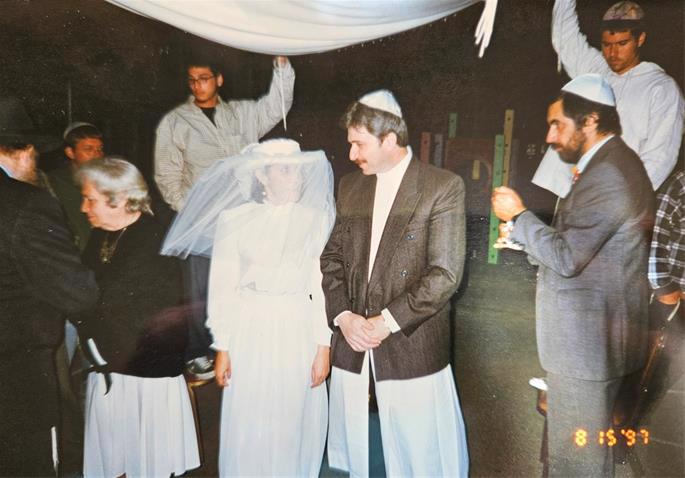
In August of 1997, Rivka and her husband stood under the chuppah.
“The chuppah took place outside the synagogue, under the stars,” says Rivka. “I looked up and thought of G‑d’s promise to our forefather Abraham that his descendants would multiply like the stars in the sky.”
Two weeks before Passover that same year, Rivka shared with her husband that she was ready to kosher the kitchen. With the help of Rabbi Ahron Hecht of Chabad Richmond Torah Center of San Francisco, their kitchen became kosher, and with it they completed the five-step transformation process.
A month later, Rivka became pregnant again.
“I didn’t have even a shadow of a doubt that we had done our part the best we could,” says Rivka. “And now it was G‑d’s turn to respond …”
She was 39, an age when blood and amniocentesis testing is standard. Rivka refused to do the testing because it could have caused additional complications, and she did not want to add more problems to her already long list.
Pointing to her age and previous experience, her doctor insisted that it was very important to understand what was going on inside.
“Can we be 100 percent certain the test results are accurate?” she asked.
“Nobody will ever give you a 100 percent guarantee,” the doctor replied.
“But I know the One!” she said, pointing her finger up.
Rivka had a wonderful doctor who knew her whole story. She asked the doctor for a favor: to pretend she was 20 years old, experiencing her first pregnancy, with her whole life ahead of her. She did not want a more detailed ultrasound or to know the baby’s gender. If any testing needed to be done, she wanted to be treated under those assumptions.
“I gave everything into His hands,” she recalls. “I agreed only that when the baby was born, the full team of specialists could come and examine the newborn, but nothing until then.”
To keep her thoughts positive, Rivka placed colorful signs emblazoned with the Chassidic adage, “Think good and it will be good!” on all the walls in her apartment and office.
“Each time my thoughts would begin to spiral, my eyes met a poster,” she explains. “The mind is a powerful thing; when we fill it with positive thoughts, our life begins to change.”
Exactly on her due date, Rivka gave birth to a healthy baby girl. They named her Menucha after Rivka’s late mother.
The delighted parents invested all their energy into educating their daughter and raising her in the finest way possible.
Before Menucha’s 12th birthday, Rivka and her husband shared the history of her arrival into this world. To celebrate her becoming a bat mitzvah, they traveled to the Holy Land and visited the Western Wall to offer their heartfelt gratitude to the One Above for the miracle of her birth.
When the time came to choose a high school for their daughter, they left their jobs and moved to the East Coast, to Philadelphia.
Menucha grew into a strong, confident, and compassionate young woman with a beautiful soul. Now married with children of her own, she prefers not to focus on her parents’ painful journey.
“As parents, we have always tried to lead by example, teaching Menucha that life’s greatest challenges can open the door to life’s greatest blessings,” says Rivka. “If our journey taught us anything, it’s that the greatest gift we can give our daughter is a deep and lasting connection to G‑d and His mitzvahs.