
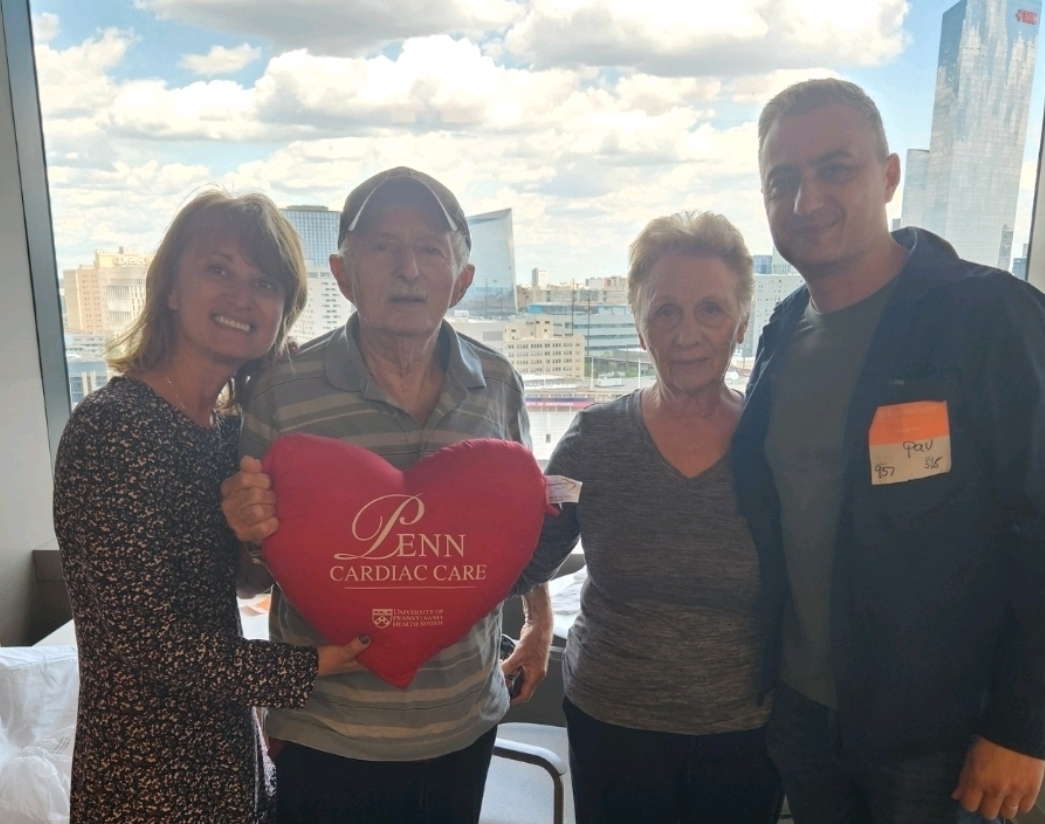
Sometimes life reminds us that miracles don’t always arrive with thunder or light—they appear quietly, through people whose kindness keeps the world beating. What began as a medical crisis for my father became, for me, an awakening of the heart—a moment that nourished my spirit and revealed the depth of compassion and unity within the Jewish people.
It began as a simple cath study in a local Philadelphia hospital. Within minutes, what seemed routine turned into a medical emergency. My father, at his youthful seventy-eight, was found to have ninety-percent blockages in four arteries. Open-heart surgery was the only way to save his life.
He was soon ambulanced to the Hospital of the University of Pennsylvania, where he would wait a week for the blood thinners to leave his system before the complex surgery. The medical team—led by the exceptional Dr. Mauer Biscotti—was remarkable in both skill and compassion. But for us, the shock was overwhelming.
My father was surrounded by family—my mother, children, grandchildren, and close relatives all gathered around him. My brother and my husband took turns at night so that someone was always by his side.
Our story, like that of many Jewish families from the former Soviet Union, carries another layer. We grew up in an atheist culture that silenced faith and stripped Jewish identity of meaning. Only after coming to America did we begin to rediscover our heritage—learning, often humbly and slowly, what it truly means to belong to the Jewish people. Even now, decades later, we are still growing into that identity, finding our place among the community, one mitzvah and one moment at a time. This experience at the hospital became another step on that journey—a reminder that the Jewish heart beats everywhere, waiting to welcome you home.
In the rush of this emergency, none of us had time to prepare properly for what lay ahead. My husband and I keep a kosher diet, so even simple things like finding a meal became unexpectedly complicated. As the hours turned into days, the challenge of staying nourished while remaining close to my father grew harder to ignore.
For two days, we survived on snacks, too focused on his condition to think of ourselves. Then Rabbi Shloimy Isaacson, who along with his father had lovingly guided my family on our journey toward Jewish identity and faith, kept mentioning a “special room” in the hospital for Jewish patients and their families. I didn’t quite understand what he meant. A room? In a major medical center?
Finally, guided by his encouragement, I went searching for it. Down a quiet hallway, past the cafeteria and near the staff washer room, I found a door marked only by a discreet sign. There was no keycard, only a small lockbox with a code written in Hebrew letters—an unspoken message that only someone who shared this heritage would recognize. I tried the combination, the lock clicked open, and the door swung inward.
Inside, I discovered what felt like a hidden sanctuary—the work of Bikkur Cholim of Philadelphia. The moment I stepped in, I felt like I had come home. The center of the room held a huge refrigerator, fully stocked with heartfelt meals prepared by caring volunteers. Inside were neatly labeled containers of lunch meats, salads, and freshly cut vegetables for convenience. A different shelf held dairy options—cheeses, yogurts, and full dairy meals ready to heat and serve. On the nearby shelves, everything was accounted for: paper plates, forks, spoons, knives, and bowls—ready for anyone who might walk in hungry and weary. There was a hot-water urn for tea, cups, candy, and snacks. Every item spoke of thoughtfulness. Someone had anticipated every possible need—a person arriving late at night, a parent too anxious to leave the bedside, a visitor who hadn’t eaten all day.
The room also had a kosher oven for Shabbat warming, and two microwaves—one for meat, one for dairy—so everyone could honor the laws of kashrut with ease. It was spotless, quiet, and infused with an unmistakable sense of care and holiness. At first, I didn’t even notice the prayer books neatly placed on the shelves; I was too overcome with emotion. I sat down and cried tears of exhaustion, relief, and overwhelming gratitude. Within a few minutes, the door opened again. A young Chassidic man walked in. Seeing me in tears, he asked gently if everything was alright. He thought I was crying from distress, and I explained that my tears came from gratitude—that I was deeply moved by this unseen kindness, this silent act of love for strangers.
He smiled with understanding. For him, the room was familiar, something he took for granted. But as we spoke, I saw him begin to see it through my eyes—the wonder of discovering such holiness in the middle of a hospital. Then he told me his wife was in the hospital giving birth.
I looked at him through tears and said, “May this child always feel the blessing of being part of such a holy nation.” Two strangers, two worlds—one of healing, one of new life—met in that sacred space, joined by the quiet power of shared faith. Later, I learned that Philadelphia’s Bikkur Cholim began with a small group of devoted community members who recognized that Jewish patients and families often found themselves in hospitals during times of deep vulnerability. What started as volunteers bringing homemade meals to bedside tables grew into a full network of care—stocked kosher pantries, Shabbat apartments, and volunteers on call day and night. Their mission: that no Jew should ever feel alone in illness or recovery.
When Friday arrived—the day of the surgery—Bikkur Cholim provided us with a nearby apartment so we could stay for Shabbat. My mother, who insisted on being close to my father, slept there to remain nearby. It was immaculate, peaceful, and within walking distance of the hospital. The beds were made with crisp, clean, beautiful sheets, and the space radiated a sense of calm and dignity. Every detail—from the lights pre-set for Shabbat to the quiet order of the apartment—reflected wisdom, love, and faith. During the long hours of surgery, I returned to that small room, made Kiddush over the challah and juice, and prayed for my father’s healing. Hours later, the doctors came out with the words I had been praying for—the surgery was successful. When my father finally opened his eyes, his first words were the traditional Jewish blessing a father gives to his daughter. That moment—his voice weak but filled with light—will remain with me forever.
Bikkur Cholim made a frightening ordeal bearable. They not only nourished us physically but embraced us spiritually. Their quiet devotion transformed the hospital into a home filled with hope. Our family felt it too—they couldn’t believe this kindness existed, and yet there it was: steady, warm, and alive.
My father’s heart was healed. And mine was uplifted and unburdened—renewed by the deep knowing that I am never alone among the Jewish people.