In Jewish thought, there is a foundational moral and legal principle called pikuach nefesh — the saving of a life. It overrides almost every other commandment in the Torah. Nothing is more sacred than human life. From the Talmud to modern times, Judaism has taught that when a life is at stake, one must act. To save another person is not only permitted — it is a commandment of the highest order. As the Sages say, “Whoever saves one life, it is as if they have saved an entire world.” When one person’s kidney can sustain another’s life, that act becomes one of the most complete fulfillments of this principle.
This teaching is not just theoretical. It defines how Jews respond to emergencies, how doctors and volunteers serve in hospitals and on the battlefield, and how ordinary people make extraordinary choices. Across the spectrum of Jewish life — from Torah-observant communities to Jews moved simply by compassion — the preservation of life is seen as sacred ground. Jews honor their commitment to kindness and view the saving of life as the ultimate form of service to their community and to Almighty God. It is an expression of Ahavat Yisrael, love for one’s fellow, and a living embodiment of divine values in the physical world.
The Renewal organization helps bring this timeless value to life. More than a medical matchmaker, Renewal walks side by side with donors and recipients, providing warmth, reassurance, and spiritual guidance throughout the process. They are known for their care, their humanity, and their ability to transform fear into courage and uncertainty into purpose.
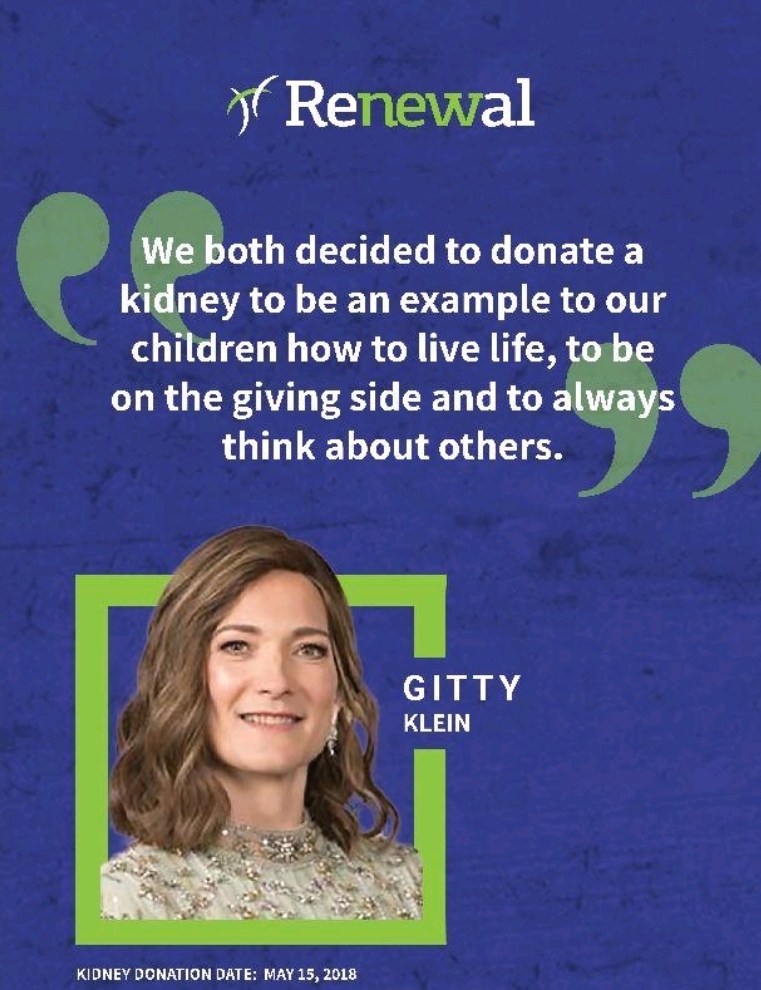
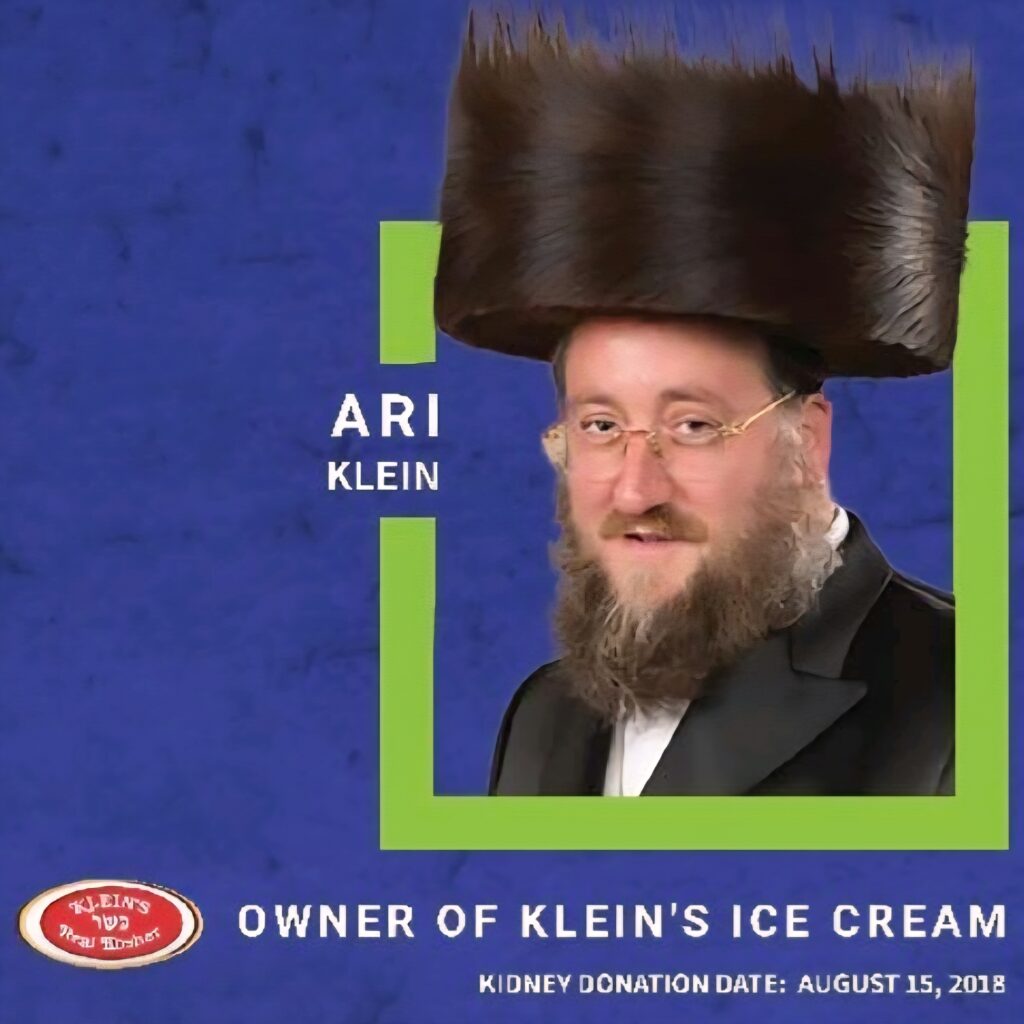
Among the many who have walked this path are Gitty and Ari Klein, Belz Chassidim from New York, known to many for their beloved family ice cream brand. But beyond the sweetness they brought into freezers across the world, the Kleins brought another kind of brand into being — one of unconditional giving and altruistic kindness. Gitty recalls, “My dormant desire awakened after watching a video of a kidney donor meet her recipient.” Moved by the gratitude she witnessed, she reached out to Renewal, and her husband Ari soon joined her in this journey.
In February 2018, Gitty learned she was a potential match and went through full medical testing, accompanied by Rabbi Steinmetz of Renewal, who supported her emotionally, mentally, and spiritually — nourishing body and soul, and even bringing coffee and pastries. On May 15, 2018, she donated her kidney in what’s called an altruistic donation — giving to a stranger. Gitty remembers walking into the operating room feeling both nervous and deeply inspired. After surgery, she was told her “mother” was doing well — the nurse didn’t realize that the patient was not her mother but another Jewish woman whose life had just been renewed. Gitty spent only two days in the hospital and recovered fully within weeks. She later met her recipient at her daughter’s wedding — a tearful, joyous reunion filled with gratitude and love.
Three months later, on August 15, 2018, her husband Ari followed her example. Though nervous before surgery, he recalls meditating and praying the night before. “When I walked into the surgical room, I felt clarity and extreme joy. I never regretted it — not even during the pain.” Ari’s recovery was swift, and soon after, he met his recipient in their home. Both donors and recipients wept and embraced, bound forever by the holiness of shared life. Both recipients were around seventy years old. Yet in Judaism, life is never measured by years alone — every moment matters. Gitty’s recipient lived nearly five more years, and Ari’s recipient is still alive today, living a Torah-observant life filled with gratitude. “As guidance and example for our children and grandchildren,” Gitty says, “we wanted to show that gratitude to Hashem means giving back — with life itself.”
Halachic authorities teach that saving a life overrides nearly all commandments. Donating a kidney, when the medical risk is low, is considered not only permissible but profoundly praiseworthy. Life holds infinite value regardless of age, status, or circumstance. Giving to a stranger is a supreme act of chesed shel emet — true, selfless kindness. Renewal’s work and the Kleins’ story have inspired countless Jews to embody these timeless values and to see in the preservation of life the very essence of serving God. The belief that life is sacred transcends divisions — between Ashkenazi and Sephardi, between Chassidic, Modern Orthodox, and secular Jews. It unites us all under one principle: life is the greatest gift from Hashem and preserving it is the highest form of worship. As Gitty reflected after her experience, “The one regret I personally — and many donors share — is the inability to do it again.”