When Mark Idisis arrived in the United States on July 4, 1990, he stepped off the plane into a nation celebrating Independence Day. Fireworks lit the sky. American flags waved everywhere. “I thought the celebration was for us,” he recalled with a smile.
For the nearly fifty-year-old Jewish refugee, the moment felt deeply symbolic. After a lifetime marked by war, loss, displacement, and decades behind the Iron Curtain, he had finally reached a country where freedom was more than an idea. His journey to America had begun nearly half a century earlier, during the Holocaust.
Mark was born on February 14, 1942, not in his hometown, but in exile in Kazakhstan after his family fled the Nazi invasion. His parents had lived in a small Jewish community in Moldova, where fewer than a thousand Jews made up a close-knit community. His father, Ben Zion Idisis, was a talented tailor, a gentle young man who loved music, enjoyed cooking, and spent his free time playing chess. Looking at old photographs today, relatives often tell Mark how much he resembles him.
“When my family looks at me,” he says, “they see my father.”
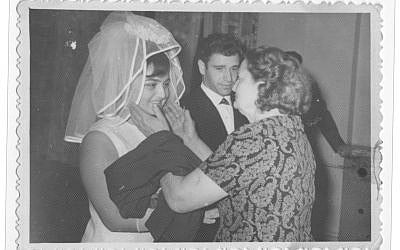
Ben Zion and Nechama Idisis married in the mid-1930s and welcomed their first child, a daughter. Their young family expected an ordinary future until June 1941, when Nazi Germany invaded the Soviet Union. Everything changed overnight.
Nechama Idisis, Mark’s mother, fled east with her three-year-old daughter, her brother, and other relatives aboard an overcrowded cargo train. The journey stretched nearly 3,500 kilometers across the Soviet Union under unimaginable conditions. Food was scarce. Water was limited. Every day was a struggle to survive. She did not even know she was pregnant.
Months later, in the bitter winter of Kazakhstan, labor began.
There was no transportation to a hospital. Mark’s uncle placed his mother on a wooden sled and pulled her through the deep snow to reach medical care.
“That is how I came into this world,” Mark says.
When the war ended in 1945, the family returned home hoping to rebuild their lives. Instead, they found strangers living in their house. Their home was gone.
Even more devastating was the absence of Mark’s father. Ben Zion had gone to war and never returned. For years, Nechama refused to give up hope. She waited for her husband, believing he might still come home. Eventually, official papers arrived declaring him missing in action. “My mother waited,” Mark says. “She never remarried.”
She raised her two children alone with the help of relatives.
One childhood memory has never left him. “We had two plates,” he recalls. “One for my sister and one for me. My mother always ate whatever was left.” That quiet act of sacrifice became one of the defining memories of his childhood. The Holocaust also destroyed much of Mark’s extended family.
His maternal grandparents were deeply religious Jews. Like many others, they believed life would continue as it always had. They could not imagine the brutality that was approaching. When Romanian and German forces occupied the region, the Jewish community was annihilated. His grandparents were murdered along with countless neighbors. On his father’s side, the losses were equally heartbreaking. His grandparents had six children, four sons and two daughters. The family was devastated by the Holocaust, leaving only fragments of what had once been a large and vibrant family.
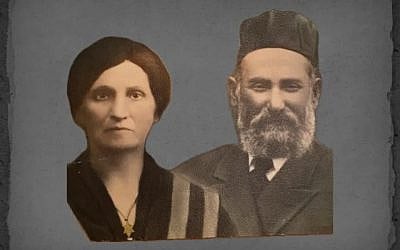
“My father was a wonderful man,” Mark says. “I wish I had known him.”
His mother rarely spoke about the war. “The pain was too great,” he explains. “She and my relatives didn’t want to talk about it.”Like many survivors, they carried their memories quietly.
In 1980, another painful separation took place. Mark’s mother and sister were finally permitted to immigrate to Israel. He remained behind in the Soviet Union.
For the next ten years, he did not see his mother. During the final years of the Soviet Union and the difficult period that followed, visiting Israel was simply not possible. The separation weighed heavily on the family until they were finally reunited a decade later.
Ten years after his mother left, Mark and his own family immigrated to the United States on July 4, 1990.
By then, Mark had married Enta, and together they began building the family that would become his greatest source of pride. Starting over in a new country was not easy.
Although he had earned a university degree in engineering and served as a chief project engineer in the Soviet Union, he arrived in America needing to begin again. The language was unfamiliar. Finding his place in a new country required patience, humility, and perseverance.
“It was a challenge,” he says. Over time, he mastered English, established himself professionally in property management, and built a successful career.
Their family is growing up in freedom, receiving a Jewish education and carrying forward the heritage that others tried to destroy.
Looking at family photographs, Mark sees something far greater than a family album.
He sees victory. “This is our victory,” he says. His journey has also brought him back to the Judaism that persecution tried to extinguish.
Today, Mark is deeply reconnecting with his Jewish faith. He attends Hebrew classes, is learning to pray, studies Torah regularly, and continues discovering the traditions that war and Soviet oppression sought to take from his generation. “It is never too late to learn,” he says.
Now in his eighties, Mark dedicates himself to sharing his testimony with students and communities. “Every time I tell my story,” he says, “I see my mother. I see my father. Everything comes back before my eyes.”
He worries deeply about Holocaust denial and the growing ignorance surrounding history.
“The denial itself is cruel,” he says. “Some people will never believe you, no matter what you tell them.” That is why he continues speaking.
“If you were born before the war, during the war, or just after it, you went through hell,” he says. “Those of us who survived have a responsibility to go to schools and universities and tell the next generation what happened.”
Mark Idisis’ life is more than a story of survival. It is the story of a Jewish child born in exile to Ben Zion and Nechama Idisis, who never had the chance to know his father, who lost grandparents, relatives, and an entire world, who endured decades behind the Iron Curtain, and who eventually found freedom in America.
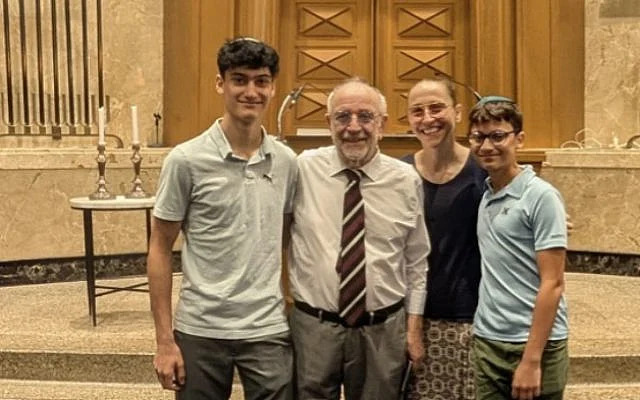
Mark shares his story with his two grandsons who attend Jewish day school and are proud of their heritage Through every audience that hears his testimony, Mark ensures that the memories of those who cannot speak continue to live.
For Mark, arriving in America on the Fourth of July was more than a coincidence. It became the final chapter of a journey that began in the darkness of the Holocaust and ended in a nation celebrating liberty. Every Independence Day reminds him that freedom is never guaranteed, but always worth protecting and that remembering the past is one of the greatest ways to safeguard the future.