

This Year the Holiday of Sukkot, Shemini Atzeret and Simchat Torah begins Monday, October 6, at 6:15pm (Philadelphia Time) – Ends on Wednesday, October 15th after Nightfall 7:01 pm (Philadelphia Time)
(In honor of Sukkot, please print BEFORE the Holiday begins -This Document contains G-d’s Name, therefore it may NOT be thrown out)
As soon as the solemn day of Yom Kippur is behind us, we focus on the traditions of the upcoming joyous holiday of Sukkot. We build a temporary house called Sukkah, which reminds us of the Clouds of Glory with which G-d surrounded the Jewish people in the desert after the Exodus from Egypt.
It is very special to experience a meal in a Sukkah and to ‘shake’ The Four Species (Lulav, Etrog, Aravot and Hadassim). If you have never done either before, visit http://www.cbscommunitycenter.com
You can also visit www.Chabad.org to find a synagogue near you where you can be accommodated.
For more information on the Holiday visit:
Sukkot 2025 – Chabad.org and Sukkot 2025 | Aish
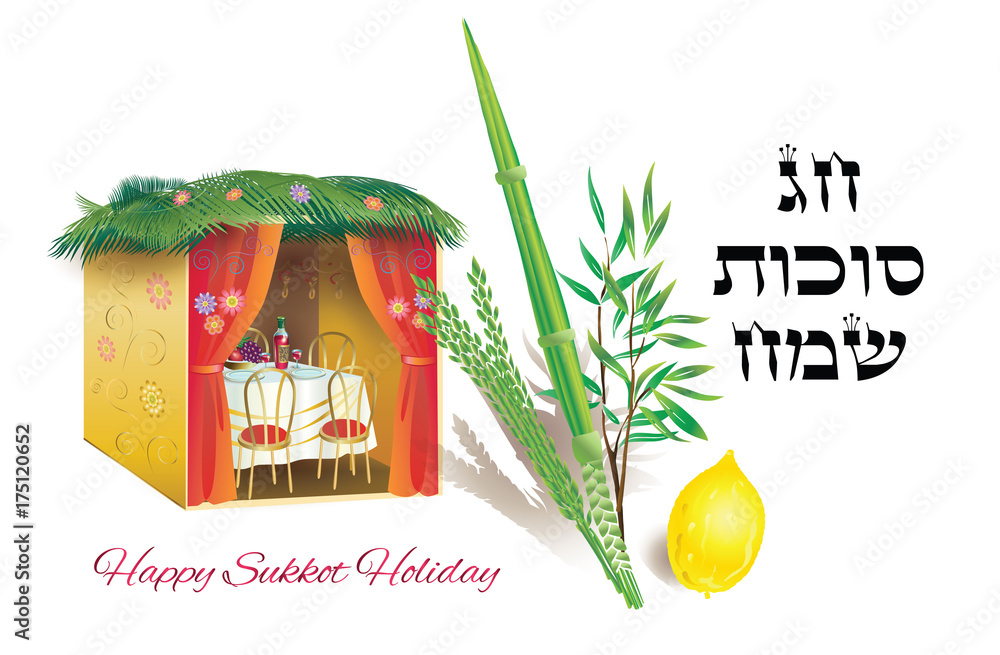
Elevating the Mundane
When we do a mitzvah (a commandment), we elevate ourselves, the object with which we did the mitzvah, and our environment. Most commandments are focused only on limited aspects of our being and limited dimensions of our environment. However, when it comes to dwelling in a Sukkah, not only is the entire body enveloped by the mitzvah, but so are the most mundane aspects of life. After all, by eating, drinking or even reading a good book in the Sukkah, we perform a mitzvah that encompasses our entire body!
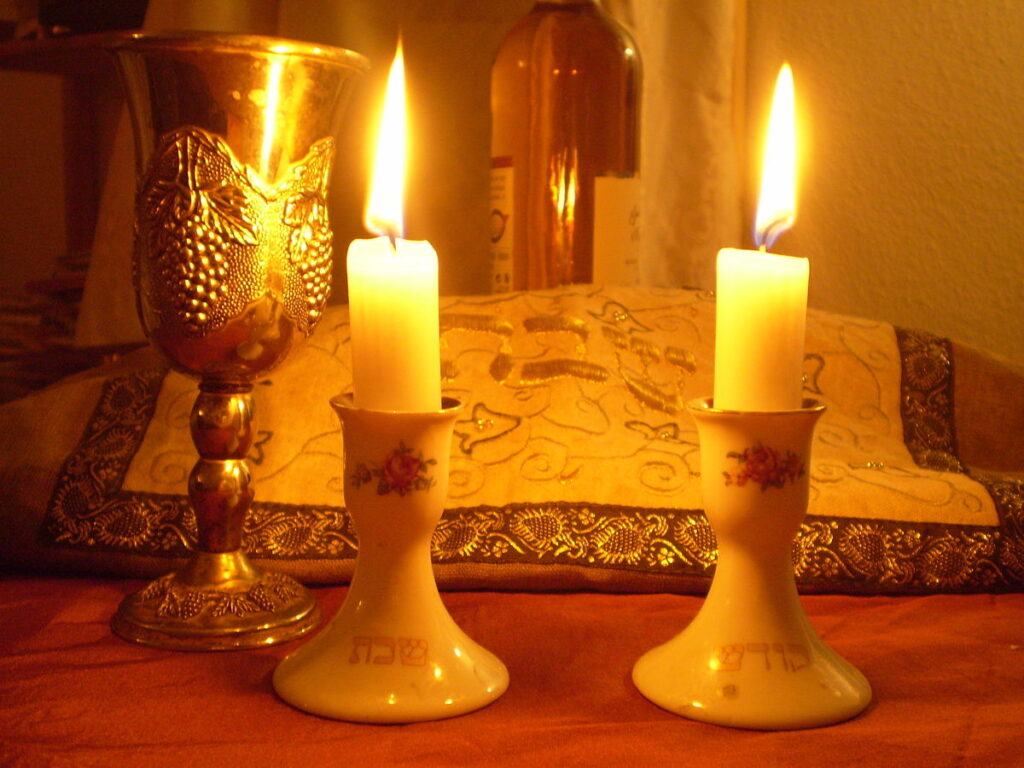
CANDLE LIGHING
Women (or if there isn’t a woman in the house, the head of the household) lights candles.
On Tuesday October 7th and Tuesday October 14th light from an existing fire of a candle you light prior to the Holiday.
For exact times in your area go to:
http://www.chabad.org/calendar/candlelighting_cdo/aid/6226/jewish/Shabbat-Candle-Lighting-Times.htm
On Monday, October 6th, (6:16 pm Philadelphia Time) and Tuesday, October 7th (after 7:13 pm Philadelphia Time)
and
On Monday, October 13th, (6:05 pm Philadelphia Time) and Tuesday, October 14th (after 7:02 pm Philadelphia Time) say two prayers below:
1. Ba-ruch A-tah Ado-nai E-lo-hei-nu me-lech ha-olam asher ki-deshanu be-mitzvo-tav ve-tzvi-vanu Lehadlik Ner Shel Yom Tov
(Blessed are You, L-rd our G-d, King of the universe, who has sanctified us with His commandments and has commanded us to light the candle of the Holiday.
2 . Ba-ruch A-tah Ado-nai E-lo-hei-nu me-lech ha-olam she-heche-ya-nu ve-ki-yi-ma-nu ve-higi-a-nu liz-man ha-zeh
(Blessed are You, Lord our G-d, King of the universe, who has granted us life, sustained us, and enabled us to reach this occasion.)
On Friday, October 10th (at 6:10 pm Philadelphia Time) say the prayer below:
Ba-ruch A-tah Ado-nai E-lo-hei-nu me-lech ha-olam asher ki-deshanu be-mitzvo-tav ve-tzvi-vanu Lehadlik Ner Shel Shabath Kodesh.
(Blessed are You, L-rd our G-d, King of the universe, who has sanctified us with His commandments and has commanded us to light the candle of Shabbath.
Evening Kiddush for both Monday and Tuesday Nights
Evening Kiddush is recited while holding a cup of kosher wine or grape juice.
(Challah should be on the table – covered)
On Monday, October 6th and Tuesday, October 7th, as well as on Monday, October 13th and Tuesday, October 14th, begin here:
Attention! our masters and our teachers:
Blessed are You, Ado-noy our God, King of the Universe, Creator of the fruit of the vine.
Blessed are You, Ado-noy our God, King of the Universe, Who chose us from among all people, and exalted us above all languages, and sanctified us with His commandments. And [You] gave us Ado-noy, our God, in love appointed festivals for gladness, festivals and times for joy…
On October 6 and 7: Succos the time of our gladness
On October 13 and 14: the eighth day, this festival of assembly, the time of our gladness
a day of holy assembly commemorating the exodus from Mitzrayim. For us have You chosen and us have You sanctified from among all peoples; and Your word is true and enduring forever Blessed are You Ado-noy, King over all the earth, Sanctifier of Yisrael and festive seasons
When sitting in the Sukka the following blessing is said:
Ba-ruch A-tah Ado-nai E-lo-hei-nu Me-lech Ha-olam Asher Kideshanu Bemitzvotav Vetzivanu Leshev Basukkah.
Blessed are You, Lord our G‑d, King of the universe, who has sanctified us with His commandments, and commanded us to sit in the Sukkah.
On all nights continue:
Ba-ruch A-tah Ado-nai E-lo-hei-nu me-lech ha-olam she-heche-ya-nu ve-ki-yi-ma-nu ve-higi-a-nu liz-man ha-zeh
Blessed are You, Lord our G-d, King of the universe, who has granted us life, sustained us, and enabled us to reach this occasion.
Pour some wine into a separate cup for guests and then drink the rest yourself without talking.
Friday Night Kiddush, October 10th
(Quietly: It was evening and it was morning.) The sixth day. So the heavens and the earth were finished, with all their complement. On the seventh day, God had completed His work which He had undertaken, and He rested on the seventh day from all His work which He had been doing. Then God blessed the seventh day and made it holy, because on it He ceased from all His creative work, which God had brought into being to fulfill its purpose.
Blessed are You God, King of the Universe, Creator of the fruit of the vine. (Others respond: “Amen”)
Blessed are You God, King of the Universe, who made us holy with his commandments and favored us, and gave us His holy Shabbat, in love and favor, to be our heritage, as a reminder of the Creation. It is the foremost day of the holy festivals marking the Exodus from Egypt. For out of all the nations You chose us and made us holy, and You gave us Your holy Shabbat, in love and favor, as our heritage. Blessed are you God, Who sanctifies Shabbat. (“Amen”)
If you are in the Sukkah:
Blessed are You, Lord our G‑d, King of the universe, who has sanctified us with His commandments, and commanded us to sit in the Sukkah.
Pour some wine into a separate cup for guests and then drink the rest yourself without talking.
Challah in Honey
Immediately following the kiddush, we perform the ritual washing for bread. Fill a large cup with water. Pass the cup to your left hand and pour three times over your right hand. Repeat by pouring on your left hand. As you wipe your hands recite the blessing:
Baruch atah A-donoy, Elo-heinu Melech Ha’Olam, asher kidshanu bemitzvotav vetzivanu al netilat yadayim.
When everyone has returned to the table, we raise the two challah loaves and recite the blessing:
Ba-ruch atah A-do-nay, E-lo-hei-nu Melech Ha-Olam, hamotzie le-chem min ha-are-tz.
Blessed are You, L-rd, our G‑d, King of the universe, who brings forth bread from the earth.
Cut the challah, dip it in honey and salt, and have a bite. Pass around pieces and make sure everyone does the same.
UNIQUE FEATURES OF SUKKOT
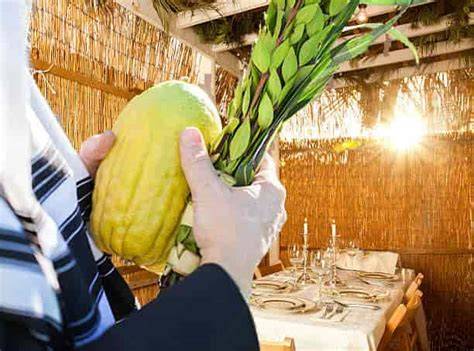
On Sukkot there is a special Mitzvah to dwell in special hut called a Sukkah. Therefore, one should eat and if one is able to even sleep in this holy abode.
A Sukkah is a hut built to provide shade. That’s why it must sit beneath the open sky—not under a patio deck or even the branches of a tree. The walls can be made of any material, as long as they are secure and don’t flap about in the wind. The roof, however, (we call it s’chach), must be of unprocessed materials which have grown from the ground. Bamboo poles, thin wooden slats, and evergreen branches are popular choices. We make sure to use enough s’chach so that the inside of the sukkah has more shade than sunlight.
On Sukkot, along with the mitzvah of dwelling in the Sukkah comes the Scriptural obligation of “taking” the Four Species as instructed by the verse, “On the first day, you must take for yourself a fruit of the citron tree, an unopened palm frond, myrtle branches and willows of the brook.”
We SHAKE the Four species on all days of Sukkot except for Shabbat, October 10th. Last time to shake is before Sunset on October 14th.
The Four Species are co-dependent, and if one of the four is missing, the mitzvah is not fulfilled. In total, seven individual items are required for the mitzvah:
1. One Lulav
2. One Etrog
3. Two Aravot
4. Three Hadassim
Why are these four plants used instead of other plants? There are two primary explanations of the symbolic significance of these plants: that they represent different parts of the body, or that they represent different kinds of Jews.
According to the first interpretation, the long straight palm branch represents the spine. The myrtle leaf, which is a small oval, represents the eye. The willow leaf, a long oval, represents the mouth, and the Etrog fruit represents the heart.
All of these parts have the potential to be used for sin, but should join together in the performance of commandments and bring Divine Light into the world.
According to the second interpretation, the Etrog, which has both a pleasing taste and a pleasing scent, represents Jews who have achieved both knowledge of Torah and performance of mitzvot (commandments). The palm branch, which produces tasty fruit, but has no scent, represents Jews who have knowledge of Torah but are lacking in mitzvot. The myrtle leaf, which has a strong scent but no taste, represents Jews who perform mitzvot but have little knowledge of Torah. The willow, which has neither taste nor scent, represents Jews who have no knowledge of Torah and do not perform the mitzvot.
We bring all four of these species together on Sukkot to remind us that every one of these four kinds of Jews is important, and that we must all be united.
The Blessing for the Four Species
| Take the etrog in your left hand with the stem (green tip) up and the pitom (brown tip) down. Take the lulav (including the palm, myrtle and willow branches bound together) in your right hand. Bring your hands together and recite the blessing below. |
Barukh atah A-do-nai, Eloheinu, melekh ha-olam asher kidishanu b’mitz’votav v’tzivanu al n’tilat lulav (Amen)
Blessed are you, Lord, our God, sovereign of the universe Who has sanctified us with His commandments and commanded us to take up the lulav (Amen)
First Day Only Add:
Barukh atah Adonai, Eloheinu, melekh ha’olam
shehecheyanu v’kiyimanu v’higi’anu laz’man hazeh.
Blessed are you, Lord, our God, sovereign king of the universe
who has kept us alive, sustained us, and enabled us to reach this season (Amen)
After you recite the blessing, turn the etrog so the stem is down and the pitom is up. (Be careful not to damage the pitom)
With the lulav and etrog together, gently shake forward (East) three times, then pull the lulav and etrog back in front of your chest. Repeat this to the right (South), then over your right shoulder (West), then to the left (North), then up, then down.
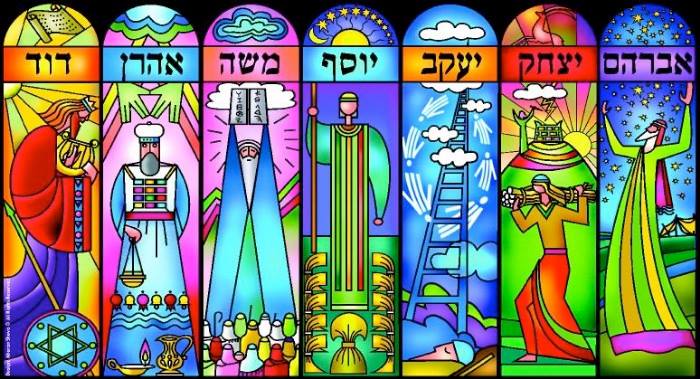
Seven Guests
Sukkah generates an intense concentration of spiritual energy. During Sukkot the souls of the seven great leaders of Israel –Abraham, Isaac, Jacob, Moses, Aaron, Joseph, and King David – actually leave Heavenly realm to partake in the Divine Light of Sukkot. Collectively these transcendent guests are known as Ushpizin, the Aramaic word meaning “guests.”
Each of the seven Ushpizin correspond to a fundamental spiritual pathway through which the world is perfected
- Abraham represents love and kindness
- Isaac represents restraint and personal strength
- Jacob represents beauty and truth
- Moses represents eternality and dominance through Torah
- Aaron represents empathy and receptivity to divine splendor
- Joseph represents holiness and the spiritual foundation
- David represents the establishment of the kingdom of Heaven on Earth
We can connect to these energies and learn from our great leaders.
Simchat Torah
Sukkot is the only holiday that really encompasses two holidays: Seven days of Sukkot and 2 Days of Shemini Atzeret [upon which we celebrate Simchat Torah on the second day]. These final two days begin at sundown on October 14th 13th (before 6:05 pm after 7:02 pm Philadelphia Time) until nightfall on October 15th. (7:01 pm Philadelphia Time)
On this final day, it is customary to conclude and then immediately begin the annual cycle of Torah reading.
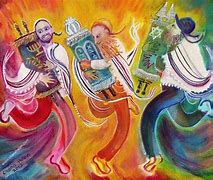
The highlight of this holiday is the boisterous singing and dancing in the synagogue, as the Torah scrolls are paraded in circles around.
Although the eighth day follows Sukkot, it is actually an independent holiday in many respects (we no longer take the Four Kinds or dwell in the sukkah). Jews outside of Israel still eat in the sukkah on the first of the two days of Shmini Atzeres.
The intermediate days (October 9, 10, 11, 12, 13 until sundown at 6:05 pm) are quasi holidays, known as Chol Hamoed.
One is permitted to drive and use electricity but should still act in ways fitting for a Holiday.
Water and Joy
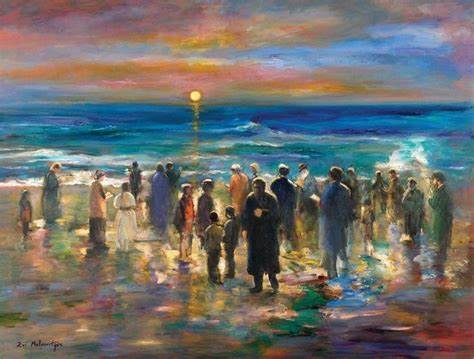
On Sukkot, G‑d determines how much rain will fall that winter (the rainy season in Israel). Thus while every sacrifice in the Temple included wine libations poured over the altar, on Sukkot, water was also poured over the altar in a special ceremony. This ritual engendered such joy that it was celebrated with music, dancing and singing all night long. This celebration was called was “Simchat Beit Hasho’evah.”
Even today, when there is no Temple, it is customary to hold nightly celebrations that include singing and dancing (and even live music during the intermediate days of the holiday).
Inspirational Story
There is a song based on the story of a little boy named Avraham who grew up to become the world famous Jewish activist Abe Foxman (Chairman of the Anti Defamation League for almost three decades). Avraham (Abe) was born on May 1, 1940 in Poland. When the Germans invaded a few months later, they herded the Jews in the ghetto, and Foxman’s parents decided to leave him with his Catholic nanny. She adopted him, baptized him and gave him a new first name and her own last name. For all intents and purposes, he grew up as a Catholic in Vilnius, Lithuania through the years 1940-1944.
When his parents returned after the war, the nanny did not want to return the child, and it took a series of court battles in the Russian legal system for the parents to obtain custody. By that time, he was a good Catholic boy, to the extent that he had even been taught to hate Jews – and he informed his parents that he didn’t plan to change.
His father wanted to introduce him to Judaism and the opportunity arrived on Simchat Torah 1945; his father hoped that a day like this would be the right moment.
On the way to the synagogue – Abe retold many years later – they passed the monastery, and he crossed himself and ran to kiss the hand of the priest who emerged from the building. His father was obviously unhappy, but he did not say a word.
They arrived at the synagogue, which was actually just a ruin now with no Torah scrolls or any holly books and less than a minyan in attendance. As they entered, little Avraham drew the attention of a Jew in a Russian soldier’s uniform. This Russian soldier approached Avrahams father and asked if he could lift Avraham on his shoulders to dance with him. The soldier danced with him all evening.
This story was told by Abe Foxman himself at an event at Yad Vashem in Jerusalem. One researcher was deeply moved by the story, and decided to look for the soldier who had danced with Abe that night.
She soon discovered that there is a song written by Abie Rotenberg, which tells about an elderly Jew he met traveling back from a wedding in Chicago The Man From Vilna – Shulem and Yanky Lemmer (youtube.com). This fellow, who was a holocaust survivor from Vilnius, clearly had difficulty walking, so Abie asked the old man why he bothered to travel to weddings altogether. The man answered that traveling to weddings was never a hassle; he was overjoyed to participate. This was his story:
He was a Russian soldier in Vilnius, Lithuania right after the war, and he decided to go to the synagogue on Simchat Torah. There were no Torah scrolls to dance with, but he noticed a little boy entering the synagogue. This was the first time in a very long time that he had seen a Jewish child… He lifted the child on his shoulders and danced with him all evening, declaring “this Jewish child will be our Torah!”
The researcher reached out to Abie Rotenberg, who connected her with that Holocaust survivor. It was really him – Leo Goldman, a rabbi in Detroit, Michigan. In 2010, sixty-five years after they danced together at Simchat Torah in Vilnius, Abe Foxman reunited with Rabbi Leo Goldman.
Leo’s perspective: When World War II broke out, Leo Goldman was a 19-year-old yeshiva student in Poland. In the beginning of the war, the Russians took over his town and recruited him into the Red Army to fight the Nazis. In one battle, he was wounded and sent to a hospital in Uzbekistan where he remained hospitalized for a long time.
In Uzbekistan, he met a Jewish girl and they married after the war, and when they left Russia, they came to Vilnius to search for living relatives. They arrived in the city during the holiday season, and on Simchat Torah, Leo decided to go to the synagogue, a shell of its previous beautiful self. There, he saw this little boy, and he realized that during all his travels from Uzbekistan to Vilnius — thousands of miles – he had seen hundreds of destroyed Jewish communities, and not a single Jewish child!
He took the child in lieu of a Torah scroll, and turned to the others and said, “Let’s dance with this child – he symbolizes the future of the Jewish people.”
In the spirit of Abe and Leo I believe we can dance once again this Simchat Torah and we will do so holding (special cards) with the names of those who died, we will be their bodies, and they will be our souls as we come together to dance with the Torah scrolls. The Torah that has been with us through all our highs and lows as a nation.
For a 2-minute video of Sukkot please visit:
https://www.youtube.com/watch?v=MoTMrJ8yUWM&feature=youtu.be